
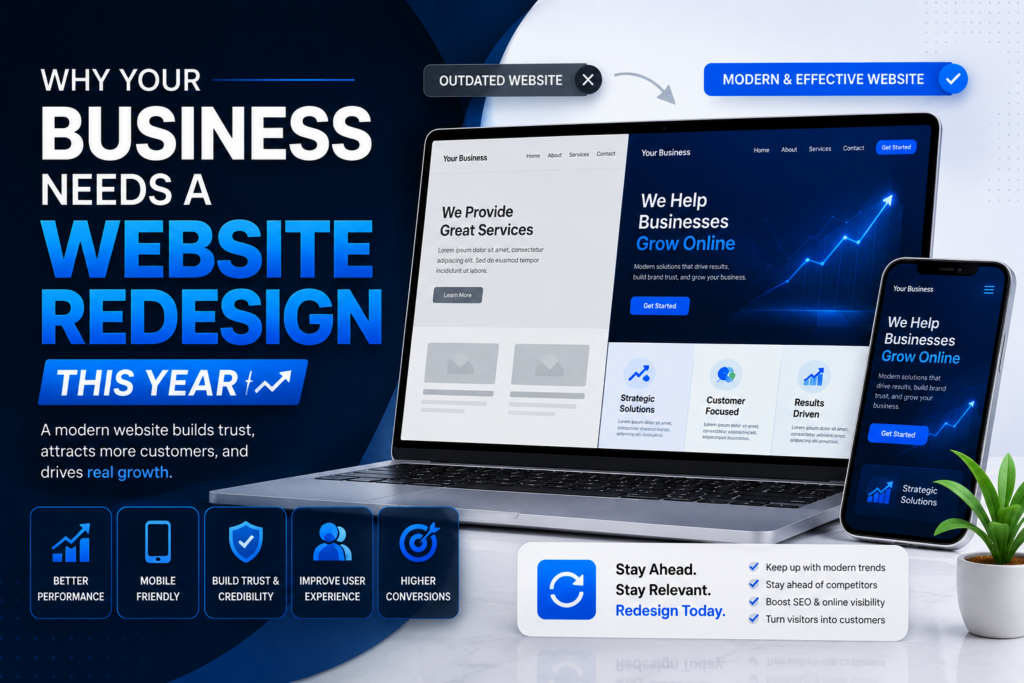
Why Your Business Needs a Website Redesign This Year
In 2026, your website is no longer just a digital brochure—it’s your most powerful sales engine, your brand’s credibility anchor, and your primary customer acquisition channel. But here’s the harsh reality: if your website hasn’t been redesigned in the last two years, you’re actively losing customers, rankings, and revenue to competitors who invested in modern, high-performance digital experiences.
This isn’t about aesthetics. This is about survival in an increasingly competitive digital marketplace. From Google’s Core Web Vitals ranking signals to AI-powered personalization, the rules of engagement have fundamentally shifted. Let’s explore why 2026 is the year your business must prioritize a website redesign—and how to do it right.
1. The Urgency: Why 2026 Is Different
The digital landscape has shifted dramatically in the past two years. Here’s what’s changed:
In Pakistan, the numbers are even more striking. With over 196 million mobile broadband subscribers and nearly 85.3% of website traffic coming from mobile devices, a website that isn’t optimized for mobile isn’t just underperforming—it’s invisible to the majority of your potential customers.
Google switched to mobile-first indexing globally in 2023—meaning Google now primarily uses the mobile version of your website for indexing and ranking purposes. If your mobile experience is slow, clunky, or difficult to navigate, your search rankings will suffer regardless of how good your desktop version looks.
2. 12 Signs It’s Time to Redesign Your Website
How do you know if your website is due for a redesign? Here are the unmistakable warning signs:
- Your bounce rate is above 55%. Industry benchmarks suggest that a bounce rate over 55% indicates poor user experience. If visitors are leaving within seconds, your design or content isn’t meeting their expectations.
- Your conversion rate has plateaued or declined. If you’re spending more on marketing but seeing diminishing returns, your website is likely the bottleneck.
- Your site isn’t mobile-responsive. In 2026, a “mobile-friendly” site isn’t enough—you need a mobile-first experience that’s re-architected for thumb-based navigation.
- Your Core Web Vitals are failing. Only about 48% of mobile sites pass all three Core Web Vitals at the 75th percentile. If you’re in the failing majority, you’re leaving ranking potential on the table.
- Your traffic is declining while rankings stay flat. As one expert notes, “The most disorienting redesign signal of this decade is a traffic chart that declines while position tracking stays green”—indicating that searchers are clicking on competitors instead.
- Your website looks outdated. The average time between major redesigns for top-performing businesses is just 2 years and 4 months. If yours is older than that, you’re behind.
- Your competitors are outranking you. If you’re consistently losing the Local Pack or organic search positions to competitors, their websites are likely delivering a better user experience.
- Your brand has evolved but your website hasn’t. If your business has expanded services, changed messaging, or shifted target audiences, your website must reflect that.
- You’re embarrassed to share your website link. This is a critical red flag. If you hesitate to send potential clients to your site, it’s time for a change.
- Your website was built more than three years ago. Businesses often fall into a costly “three-year redesign cycle” because they treat their website as a “set-it-and-forget-it” project. In today’s fast-paced digital environment, that’s a recipe for obsolescence.
- Your site lacks HTTPS or has security warnings. Google labels HTTP sites as “Not Secure,” and users are increasingly wary of sharing information on insecure sites.
- You have high exit rates on key pages. If your product pages, contact forms, or checkout pages have abnormally high exits, your design or copy is failing to convert.
3. The Business Case: ROI of a Website Redesign
Let’s talk numbers. A website redesign isn’t just about looking good—it’s about driving measurable business results. Here’s what businesses can expect from a strategic redesign:
| Metric | Expected Improvement | Source |
|---|---|---|
| Conversion Rate | 20–40% higher | App Verticals 2026 |
| Organic Traffic | 30–70% increase | Industry data |
| Customer Acquisition Cost | 10–25% lower | App Verticals 2026 |
| Sales-Qualified Leads | 15–30% higher | App Verticals 2026 |
| Overall ROI | Up to 650% within 12 months | Veloxant Solutions |
One credit union in California saw a 300% increase in loan application clicks immediately following their redesign. Another agency reported organic traffic increases of up to 266% within six months for a B2B SaaS logistics client, alongside a domain authority increase from 24 to 37.
Moreover, a well-executed redesign can reduce bounce rates by 10–15%, increase average session duration by 20–30%, and boost page views per session by 15–25%. These improvements directly correlate with better SEO performance, as Google’s algorithms interpret these as positive user signals.
4. Core Web Vitals: Google’s Performance Mandate
Google’s Core Web Vitals (LCP, INP, and CLS) are confirmed ranking signals that measure real-world user experience. In 2026, they remain a critical component of SEO success:
- LCP (Largest Contentful Paint) – measures loading performance. Pages with poor LCP scores have measurably higher bounce rates. Aim for LCP < 2.5 seconds.
- INP (Interaction to Next Paint) – measures responsiveness. INP officially replaced FID (First Input Delay) in March 2024. Aim for INP < 200 milliseconds.
- CLS (Cumulative Layout Shift) – measures visual stability. Shifting content frustrates users and damages trust. Aim for CLS < 0.1.
According to 2025–2026 industry analysis, Core Web Vitals account for roughly 10–15% of overall ranking signals. For highly competitive keywords, sites that meet all three metrics have reported an 8–15% improvement in search visibility. Sites improving their Web Vitals commonly see organic traffic gains in the 10–20% range and conversion lifts that can exceed 15–30%.
To improve Core Web Vitals, a redesign should focus on:
- Optimizing images – use next-gen formats (WebP, AVIF), lazy loading, and proper sizing.
- Minimizing JavaScript – reduce unused JS, defer non-critical scripts, and use code splitting.
- Improving server response times – leverage CDN, caching, and efficient hosting.
- Eliminating layout shifts – specify dimensions for media elements and avoid injecting content above existing content.
5. The Mobile-First Imperative
Mobile traffic has grown by over 8,700% since 2009, jumping from under 1% to over 63% of global web traffic. In Pakistan, the figure is even higher—85.3% of website traffic comes from mobile devices.
Google completed its full mobile-first indexing rollout by 2024, meaning 100% of websites are now ranked based on their mobile version—not desktop. Ignoring mobile optimization isn’t just a UX problem; it’s an SEO disaster.
A “mobile-friendly” site that merely shrinks desktop content for smaller screens is no longer sufficient. In 2026, you need a mobile-first approach that re-architects the entire experience for thumb-based navigation, touch interactions, and the unique behaviors of mobile users.
Key mobile-first design principles:
- Touch-friendly targets – buttons and links should be at least 48px in size with adequate spacing.
- Simplified navigation – use hamburger menus, bottom navigation bars, or collapsible accordions.
- Prioritize content hierarchy – surface the most important information first, and use progressive disclosure.
- Optimize forms for mobile – use input types that trigger appropriate keyboards (number pad, email, etc.).
- Leverage mobile-specific features – click-to-call, location-based services, and deep linking to apps.
6. Modern Web Design Trends That Drive Results
2026 web design is about performance, personalization, and personality. Here are the trends that matter:
- AI-Powered Personalization: Websites are getting smarter about adapting to individual visitors, creating tailored experiences that boost engagement and conversions. This includes dynamic content blocks, product recommendations, and personalized CTAs based on user behavior.
- Performance-First Design: Design decisions are increasingly driven by speed and low-powered device compatibility. Every element must justify its performance cost.
- Human-Centered Aesthetics: Brands are moving away from cookie-cutter templates toward layouts, typography, and visual styles that reflect their unique identity.
- Micro-Interactions: Scroll-triggered animations and responsive interactions reduce cognitive load, increase engagement, and improve conversion rates.
- Bold Typography: Kinetic and variable typography is becoming a core brand identifier.
- Sustainable Design: Sustainability is central to web design in 2026, shaping how sites are built and hosted. This includes reducing carbon footprint by optimizing code and using green hosting.
- Dark Mode & High Contrast: Offering a dark mode option improves accessibility and user preference.
- Immersive Storytelling: Full-screen video backgrounds, parallax scrolling, and interactive timelines are being used to tell brand stories more effectively.
7. User Experience (UX) & Conversion Rate Optimization
A redesign is the perfect opportunity to overhaul your user experience. Poor UX is the #1 reason visitors don’t convert. Here’s what to focus on:
- Clear Value Proposition: Within 5 seconds, visitors should understand what you offer, why it matters, and what to do next.
- Intuitive Navigation: Your menu structure should reflect user mental models. Use clear labels, limit top-level items to 5-7, and provide breadcrumbs.
- Effective Calls-to-Action (CTAs): Use action-oriented, benefit-driven language. Place CTAs above the fold and at logical decision points.
- Trust Signals: Display testimonials, case studies, partner logos, security badges, and certifications prominently.
- Form Optimization: Reduce friction by minimizing fields, using auto-fill, providing clear error messages, and offering multiple submission options (e.g., social login).
- Search Functionality: Ensure your search bar is easy to find and returns relevant results quickly.
- A/B Testing: After launch, continuously test variations of headlines, CTAs, layouts, and images to improve performance.
8. Accessibility: Designing for Everyone
Web accessibility isn’t just a moral imperative—it’s also a business and SEO opportunity. In 2026, accessibility is increasingly becoming a ranking factor and a legal requirement in many regions. Moreover, accessible design often improves usability for all users.
Key accessibility principles (WCAG 2.1 AA compliance):
- Perceivable: Provide text alternatives for non-text content, captions for multimedia, and sufficient color contrast.
- Operable: Ensure all functionality is available from a keyboard, give users enough time to read content, and avoid content that causes seizures.
- Understandable: Make text readable and predictable, and help users avoid and correct mistakes.
- Robust: Maximize compatibility with current and future user agents, including assistive technologies.
Practical steps for your redesign:
- Use semantic HTML (header, nav, main, article, footer) to improve screen reader navigation.
- Ensure all images have descriptive alt text.
- Maintain a contrast ratio of at least 4.5:1 for normal text.
- Provide skip navigation links.
- Make all interactive elements focusable and visible.
9. AI and Chatbot Integration: The New Normal
In 2026, AI-powered chatbots and virtual assistants are no longer optional—they’re expected. Businesses that integrate AI into their websites see higher engagement, lower support costs, and improved conversion rates.
Benefits of AI chatbots:
- 24/7 availability – answer customer queries instantly, even outside business hours.
- Lead qualification – chatbots can pre-qualify leads by asking relevant questions and routing them to sales teams.
- Personalized recommendations – use browsing history and user data to suggest products or services.
- Reduced cart abandonment – chatbots can offer discounts or answer questions during checkout.
During your redesign, consider:
- Embedding a chatbot widget on key pages (home, product, contact).
- Using natural language processing (NLP) to understand user intent.
- Integrating with your CRM to capture leads and track interactions.
- Designing a conversational UI that matches your brand voice.
10. Security: HTTPS, SSL, and Beyond
Website security is a trust signal and a ranking factor. Google has confirmed that HTTPS is a lightweight ranking signal, but more importantly, browsers now warn users when they visit non-secure sites.
Key security considerations for your redesign:
- Install an SSL certificate – encrypt data transmitted between your server and visitors.
- Use strong password policies – enforce complex passwords and two-factor authentication for admin areas.
- Regularly update software – keep CMS, plugins, and themes up-to-date to patch vulnerabilities.
- Implement a Web Application Firewall (WAF) – block malicious traffic and prevent attacks.
- Back up your website regularly – ensure you can restore quickly in case of a breach.
- Comply with data protection regulations – if you handle personal data, ensure GDPR/CCPA compliance (or Pakistan’s upcoming data protection laws).
11. Content Strategy: Don’t Just Redesign, Revitalize
A redesign is the perfect time to audit and improve your content. Many businesses make the mistake of simply porting old content into a new design. That’s a missed opportunity.
Steps for a content-led redesign:
- Content audit: Evaluate every page. Keep high-performing pages; update outdated ones; consolidate thin content; remove irrelevant pages.
- Keyword refresh: Update your keyword strategy based on current search trends and user intent. Add new long-tail keywords and topics.
- Improve readability: Use short paragraphs, bullet points, subheadings, and simple language. Aim for a Flesch score above 60.
- Add multimedia: Incorporate videos, infographics, and interactive elements to increase engagement and time on site.
- Create new content: Identify gaps in your content library and plan new blog posts, case studies, or white papers.
- Update meta data: Rewrite title tags and meta descriptions to improve click-through rates from search results.
12. Choosing the Right CMS and Hosting for 2026
A redesign isn’t just about visuals—it’s about the underlying technology. Your CMS and hosting directly impact performance, scalability, and maintenance.
CMS considerations:
- Ease of use: Your team should be able to update content without developer help.
- Performance: Headless or decoupled CMS (e.g., Contentful, Strapi) offer superior performance and flexibility.
- Security: Regular updates and patches are crucial. Open-source CMS like WordPress require active maintenance; proprietary platforms often handle security for you.
- Integrations: Ensure the CMS integrates with your CRM, marketing automation, and analytics tools.
Hosting considerations:
- Speed: Choose a hosting provider with fast server response times, SSD storage, and CDN integration.
- Uptime: Look for 99.9% uptime guarantees.
- Scalability: Ensure your hosting can handle traffic spikes without crashing.
- Location: For Pakistani businesses, choose a provider with servers in the region or a global CDN with edge locations in Asia.
13. Common Redesign Mistakes That Kill ROI
Avoid these common pitfalls:
- Redesigning for aesthetics, not performance. A beautiful site that loads slowly will hurt your rankings and conversions.
- Ignoring SEO during the redesign. Changing URLs without proper 301 redirects, removing optimized content, or breaking internal links can devastate your search visibility.
- Neglecting mobile optimization. If your redesign prioritizes desktop over mobile, you’re optimizing for the minority of users.
- Removing what works. Don’t throw away high-performing pages, content, or CTAs just because they’re “old.”
- Failing to test. Launch without A/B testing and you’re flying blind.
- No clear goals. If you can’t define what success looks like, you won’t achieve it.
- Rushing the launch. Cramming testing and QA into the last week leads to bugs and broken experiences.
- Ignoring user feedback. Don’t design in a vacuum—involve real users in testing and incorporate their feedback.
14. Why This Matters for Pakistani Businesses
In Pakistan’s fast-growing digital economy, the stakes are even higher. With 85.3% of web traffic coming from mobile and internet penetration expanding rapidly, your website is often the first and only impression potential customers will have of your business.
Competitors in Pakistan’s major cities—Lahore, Karachi, Islamabad—are investing heavily in modern web experiences. If your website is outdated, slow, or difficult to use, you’re actively driving customers to competitors who have invested in their digital presence.
Additionally, consider the local payment ecosystem—integrating JazzCash, Easypaisa, or bank transfer options for e-commerce can significantly boost conversion rates. Also, ensure your contact information (phone, address, email) is prominently displayed, as trust is a major factor in the Pakistani market.
15. How to Approach a Website Redesign the Right Way
A successful redesign isn’t a project—it’s a strategic process. Here’s a framework for success:
- Audit your current site. Analyze analytics, heatmaps, user feedback, and technical performance. What’s working? What’s broken?
- Define clear goals. Are you trying to increase conversions? Improve SEO? Reduce bounce rate? Launch new services? Be specific and measurable (e.g., “increase leads by 30% in 6 months”).
- Research your competitors. What are they doing well? Where are their gaps? Use this intelligence to differentiate.
- Develop a project plan. Set timelines, budget, and resource allocation. Include milestones for design, development, testing, and launch.
- Plan your information architecture (IA). Map out user journeys and ensure intuitive navigation. Use card sorting and user flows.
- Create wireframes and prototypes. Test early designs with real users to validate assumptions.
- Design with performance in mind. Every design decision should consider Core Web Vitals impact.
- Develop and test rigorously. Test on multiple devices, browsers, and network conditions. Run performance audits (Lighthouse, GTmetrix).
- Launch with an SEO checklist. Ensure proper 301 redirects, updated sitemaps, and preserved rankings. Monitor analytics closely.
- Monitor and iterate. A redesign isn’t finished at launch. Use analytics and user feedback to continuously improve.
16. Real-World Case Studies: Redesign Success Stories
Case Study 1: B2B SaaS Logistics Company
A logistics software provider redesigned their website with a focus on clear value propositions, improved navigation, and optimized forms. Within 6 months, they saw a 266% increase in organic traffic and a domain authority increase from 24 to 37. Their lead conversion rate tripled.
Case Study 2: Credit Union in California
After a complete redesign that prioritized mobile responsiveness and simplified loan application forms, this credit union experienced a 300% increase in loan application clicks within the first month.
Case Study 3: Pakistani E-commerce Store
A Lahore-based fashion retailer redesigned their site with mobile-first design, WhatsApp integration, and faster checkout. Their mobile conversion rate increased by 45%, and overall revenue grew by 32% in 3 months.
17. Final Thoughts: Don’t Wait Until It’s Too Late
Your website is the digital face of your business. In 2026, a dated, slow, or poorly designed website isn’t just an embarrassment—it’s a liability that costs you customers, rankings, and revenue every single day.
The statistics are undeniable: 73% of consumers judge your credibility by your website design. 47% of users leave due to poor usability. 73% abandon sites that aren’t mobile-responsive. And the businesses that invest in strategic redesigns see 20–40% higher conversions and up to 650% ROI.
The question isn’t whether you need a website redesign—it’s how soon you can start. Every month you wait is another month of lost opportunities, lower rankings, and revenue left on the table.
📌 Ready to Redesign Your Website?
Sherazi Marketing Solutions helps businesses in Pakistan build high-performance, conversion-focused websites that rank and convert.
Visit Sherazi Marketing Solutions →