
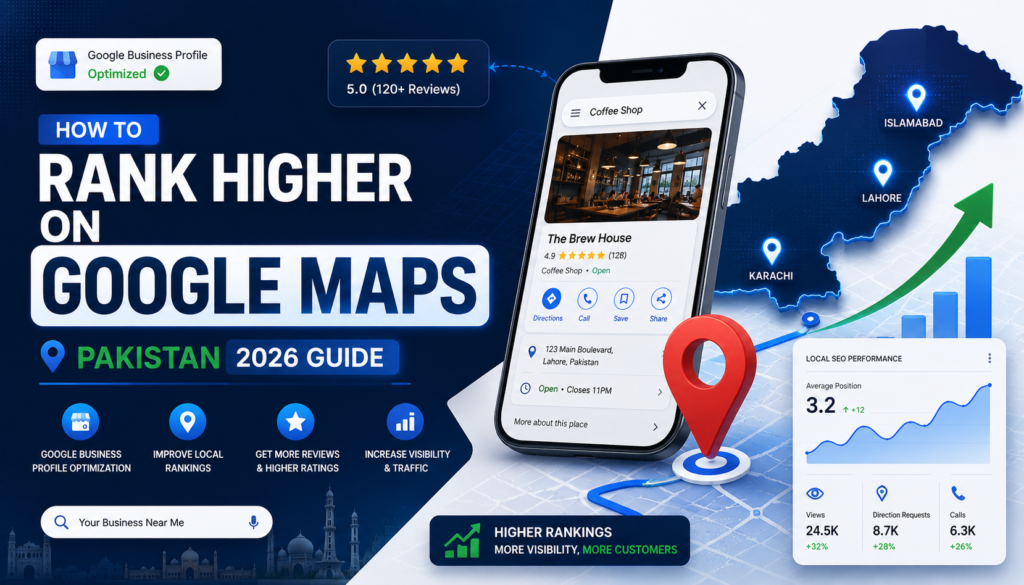
How to Rank Higher on Google Maps in Pakistan (2026 Guide)
Google Maps isn’t just a navigation app anymore—it’s the new storefront for Pakistani businesses. When someone in Lahore searches for “best digital marketing agency” or a user in Karachi looks for “AC repair near me,” the first thing they see is the Local Pack—three businesses pinned on a map. If you’re not in that pack, you’re invisible to high-intent customers ready to buy.
In 2026, ranking on Google Maps in Pakistan demands more than a basic listing. Google’s algorithm now weighs trust signals, real-world popularity, AI-driven attributes, and engagement velocity more heavily than ever before. This guide walks you through every signal that matters—and shows you exactly how to dominate local search in Pakistan’s most competitive cities.
1. Why Google Maps Matters More Than Ever in Pakistan
Pakistan is a mobile-first market. More than 76% of local searches happen on smartphones, and users expect instant, location-aware results. Whether it’s finding a “dentist near DHA Karachi” or “property dealer in Rawalpindi,” Google Maps is the primary discovery channel.
For Pakistani businesses—from fintech startups and banking branches to restaurants and service providers—ranking in the top three Google Maps results directly drives calls, foot traffic, and revenue. If your competitors are in the Local Pack and you’re not, they’re taking the customers you should be getting.
2. How Google Maps Ranking Works in 2026
Google’s local algorithm rests on three core pillars—but in 2026, each pillar has evolved:
- Relevance – How closely your business matches the search query. This is driven by your primary category, services, attributes, and description.
- Distance – How close your verified location is to the searcher. Google now considers commute patterns and likely destinations, not just GPS coordinates.
- Prominence – How well-known and trusted your business is. This is built through reviews, citations, backlinks, and behavioral signals like clicks and calls.
According to the 2026 Local Search Ranking Factors report (compiled from 47 of the world’s top local SEO experts), the weight of each signal category breaks down like this:
| Signal Category | Estimated Weight | Key Elements |
|---|---|---|
| GBP Signals | 36% | Primary category, business name keywords, hours, attributes, photos |
| Review Signals | 17% | Quantity, velocity, recency, and review text keywords |
| On-Page Signals | 16% | NAP on website, geo-modified titles, schema markup, mobile optimization |
| Citation Signals | 11% | Consistent NAP across directories (quality over quantity) |
| Behavioral & Link Signals | ~20% | Clicks, calls, direction requests, locally relevant backlinks |
3. Step-by-Step Google Maps Optimization for Pakistani Businesses
3.1 Claim & Verify Your Google Business Profile
This is non-negotiable. If you haven’t claimed your profile, anyone can suggest edits—your hours, phone number, or address could be wrong without your knowledge. Claim your GBP and verify ownership (usually via postcard, phone, or email). In 2026, Google also offers video verification for certain categories, which is faster.
3.2 Choose the Most Specific Primary Category
According to Whitespark’s 2026 data, your primary category is the #1 ranking factor for Google Maps. Don’t choose “Lawyer” when you can choose “Personal Injury Attorney.” The more specific, the better. For Pakistani businesses, this means using categories like “Digital Marketing Agency in Lahore” rather than just “Marketing Agency.”
3.3 Add Every Service, Product, and Attribute
In April 2026, Google rolled out 54 new attributes that act as binary filters for discovery. Attributes like has_online_appointments, accepts_walk_ins, or offers_emergency_service determine whether your business appears when users toggle filters.
3.4 Write a Keyword-Rich Description (for Humans & AI)
Your GBP description should include location-specific keywords naturally—e.g., “digital marketing agency in Islamabad serving DHA, Blue Area, and F-7”. But don’t keyword-stuff. Google’s AI reads for real questions and natural language, not just keywords.
3.5 Upload Real Photos & Short Videos Weekly
Google rewards active, real-looking profiles. Stock images don’t build trust. Upload real photos of your team, your office, your products, and before/after shots. A short video (under 1 minute) of the owner introducing the business can significantly boost engagement.
3.6 Keep Your Hours Accurate—They’re a Ranking Signal
Being open when users search is now the No. 5 local pack ranking factor. Rankings tend to drop when a business is listed as closed. Set special hours for holidays in advance, and audit your hours quarterly.
4. Deep Dive into Google’s Three Pillars (With Pakistan Examples)
4.1 Relevance – Beyond Keywords
Relevance is about intent matching. If a user searches “best biryani in Karachi,” Google looks for restaurants that have “biryani” in their description, menu items, and reviews. But in 2026, Google also scans user-generated photos with AI—if your profile has photos of biryani, you’re more relevant.
Pakistan example: A restaurant in Lahore should mention “authentic Punjabi dishes” and “mutton karahi” in their description, but also add photos of those dishes with descriptive alt text.
4.2 Distance – The “Service Area” Strategy
Distance is fixed based on your address, but you can influence it by setting service areas. If you serve multiple cities (e.g., Islamabad and Rawalpindi), set both as service areas. Google may show your profile to users in those cities even if you’re slightly farther.
4.3 Prominence – The Trust Factor
Prominence is a composite of offline presence, brand mentions, and online authority. In Pakistan, having a physical storefront in a known area (like Saddar, DHA, or Gulberg) boosts prominence. Online, it’s built through high-quality backlinks from Pakistani news sites, business directories, and industry blogs.
5. Mastering Google Business Profile Attributes in 2026
Attributes are micro-signals that tell Google exactly what you offer. The 2026 update added 54 new attributes across categories like “LGBTQ+ friendly,” “Women-owned,” “Available by appointment,” “Outdoor seating,” “Parking,” and more.
For Pakistani businesses, the most impactful attributes are:
- “Online appointments” – crucial for clinics, consultants, and legal services.
- “Offers delivery” – essential for restaurants and retail.
- “Wheelchair accessible” – builds inclusivity and trust.
- “Free WiFi” – a common filter for cafes and co-working spaces.
Filling out all relevant attributes can boost your relevance score by up to 15%, according to a 2026 Moz study.
6. The Review Generation Playbook (Volume, Velocity & Response)
Reviews are no longer just social proof—they’re currency. Google now allows anonymous reviews, added QR codes for instant feedback, and pulls signals from other platforms like Yelp and Facebook.
• Volume: A business with 150 reviews at 4.7 stars consistently outranks one with 30 reviews at 5.0 stars.
• Velocity: Aim for 2–3 new reviews per week.
• Recency: Reviews from the last 90 days carry more weight.
• Response rate: Reply to every review within 24–48 hours.
6.1 How to Get More Reviews in Pakistan
- SMS/WhatsApp: Send a polite message with a direct link to your review page right after a service.
- QR Codes: Place QR codes on receipts, desks, and storefronts that lead directly to your GBP review form.
- Email Drip: Set up an automated email sequence that asks for feedback 3 days after a purchase.
- Incentives (allowed): You can offer a small discount on the next visit—but never buy fake reviews.
6.2 Handling Negative Reviews Like a Pro
Negative reviews are inevitable. The key is response quality. A well-handled negative review can actually improve trust.
Never argue publicly. Take it offline. Google rewards businesses that respond empathetically and quickly.
7. Pakistan-Specific Local SEO Strategies
7.1 Target City & Neighborhood Keywords
Instead of “digital marketing agency,” use “digital marketing agency in Lahore,” “SEO services in Karachi,” or “social media marketing in Islamabad”. Create location-specific landing pages on your website for each city or area you serve.
7.2 Build Pakistani Citations
Consistent NAP (Name, Address, Phone) across Pakistani directories like PSEB, PakBiz, GoodFirms, and local chamber of commerce listings strengthens your citation profile. Quality and consistency matter more than the sheer number of citations.
7.3 Leverage WhatsApp & Local Messaging
In Pakistan, WhatsApp is a primary communication channel. Add your WhatsApp number to your GBP and website. Google tracks engagement signals—if users are clicking to call or message you, it boosts your prominence.
7.4 Mobile-First Experience Is Mandatory
Most local searches in Pakistan happen on smartphones. If your website is slow, has tiny buttons, or confusing navigation, visitors will bounce—and Google will notice. Optimize for Core Web Vitals and ensure your contact form and phone number are one-tap accessible.
7.5 Use Urdu/English Hybrid Keywords
Many Pakistani users search in Roman Urdu or mixed language (e.g., “best restaurant in Lahore” or “buri auto repair”). Include these natural hybrids in your profile description and posts.
8. Advanced Tactics for 2026: AI, Posts, and Behavioral Signals
8.1 Make Your Profile “AI-Ready”
Google’s AI (including Gemini) now curates dynamic lists and reads unstructured user-generated context. Answer real customer questions inside your profile and on your website. Use FAQ schema and LocalBusiness schema to help AI understand your business.
8.2 Use Google Posts & Q&A
Regular Google Posts (weekly or bi-weekly) signal that your profile is actively managed. Respond to Q&A questions promptly—this builds trust and provides fresh content for Google’s algorithm.
- Post ideas: New product launches, special offers, team highlights, behind-the-scenes, or community events.
- Q&A: Pre-answer common questions in the Q&A section. This proactively shapes user perception.
8.3 Monitor Your Profile for Edits
Competitors or users can suggest edits to your GBP. Use a monitoring tool (like Ahrefs’ GBP Monitor) to get alerts when someone changes your hours, address, or photos.
8.4 Track Behavioral Signals
Google’s 2026 ranking system heavily incorporates user behavior: click-through rates, time spent viewing profiles, calls, and direction requests all influence rankings. Encourage users to click “Get Directions” and call directly from your profile.
9. Technical SEO: The Backbone of Local Ranking
9.1 Schema Markup (LocalBusiness)
Implement JSON-LD schema on your website with your business name, address, phone, opening hours, and geo-coordinates. This helps Google unambiguously understand your location and services.
9.2 Embed Your Location on Every Page
Add a Google Maps embed on your contact page and footer. It reinforces location relevance.
9.3 Page Speed & Mobile Usability
Google uses Core Web Vitals as a ranking signal. Use tools like PageSpeed Insights to fix LCP (Largest Contentful Paint) and CLS (Cumulative Layout Shift). In Pakistan, where internet speeds vary, a fast site is a competitive advantage.
10. Local Link Building in Pakistan
Backlinks from authoritative Pakistani websites signal to Google that your business is part of the local ecosystem. Some strategies:
- Local news features: Pitch stories to Pakistani tech blogs, business journals, and local newspapers.
- Partnerships: Get listed on partner websites (e.g., suppliers, distributors).
- Sponsorships: Sponsor local events, charities, or schools and ask for a link on their event page.
- Guest posting: Write for high-authority Pakistani blogs in your industry with a link back to your site.
11. Optimizing for Voice Search & Conversational Queries
With Google Assistant and Alexa usage rising in Pakistan (especially among Gen Z), voice queries are becoming a significant channel. Voice searches are longer and more conversational.
Examples: “Where can I get a good laptop repair shop near Gulberg?” vs. “laptop repair Gulberg.”
Optimization tips:
- Include question phrases in your description and posts (e.g., “Looking for the best digital marketing agency in Lahore? We’re here to help.”).
- Use FAQ schema to directly answer common questions.
- Make sure your GBP phone number is click-to-call—voice searchers often tap to call immediately.
12. Competitor Analysis: Outranking Your Rivals
You can’t win if you don’t know who you’re up against. Here’s how to audit your competitors’ Google Maps presence:
- Identify top 3 competitors: Search for your primary keyword (e.g., “best dentist in Karachi”) and note the top 3 in the Local Pack.
- Analyze their GBP: Check their categories, attributes, review count, and average rating. Are they posting regularly? How complete is their profile?
- Backlink profile: Use tools like Ahrefs or SEMrush to see who links to them. Target similar or better websites.
- Review sentiment: Read their recent reviews. What do customers praise? What do they complain about? Use those insights to differentiate your service.
13. Tracking Your Rankings & ROI
What gets measured gets managed. To truly dominate, you need to track your Google Maps performance regularly.
- GBP Insights: Google’s own dashboard shows search queries, profile views, and actions (calls, direction requests). Monitor these weekly.
- Third-party rank trackers: Tools like BrightLocal, Whitespark, or SEMrush can track your exact position in the Local Pack across different cities.
- Conversion tracking: Set up call tracking numbers and use UTM parameters on your website to see how many leads come from Maps.
- Review monitoring: Set up alerts for new reviews so you can respond immediately.
14. Common Mistakes That Kill Google Maps Rankings in Pakistan
- Inconsistent NAP: Different name, address, or phone number across your website, GBP, and directories breaks trust.
- Ignoring reviews: Not responding to reviews—or worse, not actively acquiring them—signals neglect.
- “Set it and forget it”: A static profile with perfect NAP but no fresh photos, posts, or updates will slowly drop in rankings.
- Wrong category: Choosing a broad category limits the searches you can rank for.
- No local content: A website without location-specific pages or blog posts weakens your relevance signal.
- Keyword stuffing: Overloading your description with keywords makes it unreadable and triggers spam filters.
15. Future-Proofing Your Google Maps Strategy for 2027 and Beyond
Google’s algorithm evolves constantly. Here’s how to stay ahead:
- Embrace AI-generated insights: Use Google’s AI suggestions for posts, attributes, and Q&A. They often know what works best.
- Focus on real-world signals: Google is testing integration with credit card transactions and store visit counts (via mobile location data). The busier your store, the higher you may rank.
- Video content: Short-form video (Reels, Shorts) linked to your GBP is becoming a strong ranking signal.
- Sustainability & ethics: Attributes like “eco-friendly” or “locally sourced” are gaining traction and may become filters in 2027.
16. Final Thoughts: Own Your Local Search Presence in 2026
Ranking on Google Maps in Pakistan isn’t about hacks—it’s about trust, relevance, and consistent activity. The businesses that win in 2026 are those that treat their Google Business Profile as a live engagement channel, not a static directory listing.
Start with the fundamentals: claim your profile, choose the right category, get real reviews, and keep your information accurate. Then layer in advanced tactics: AI-ready content, fresh attributes, weekly photos, and behavioral engagement. The result? Higher rankings, more calls, and a steady stream of local customers.
📌 Need Help Ranking on Google Maps?
Sherazi Marketing Solutions is a leading digital marketing agency in Pakistan, helping banks, fintech startups, and local businesses grow through data-driven local SEO.
Visit Sherazi Marketing Solutions →