
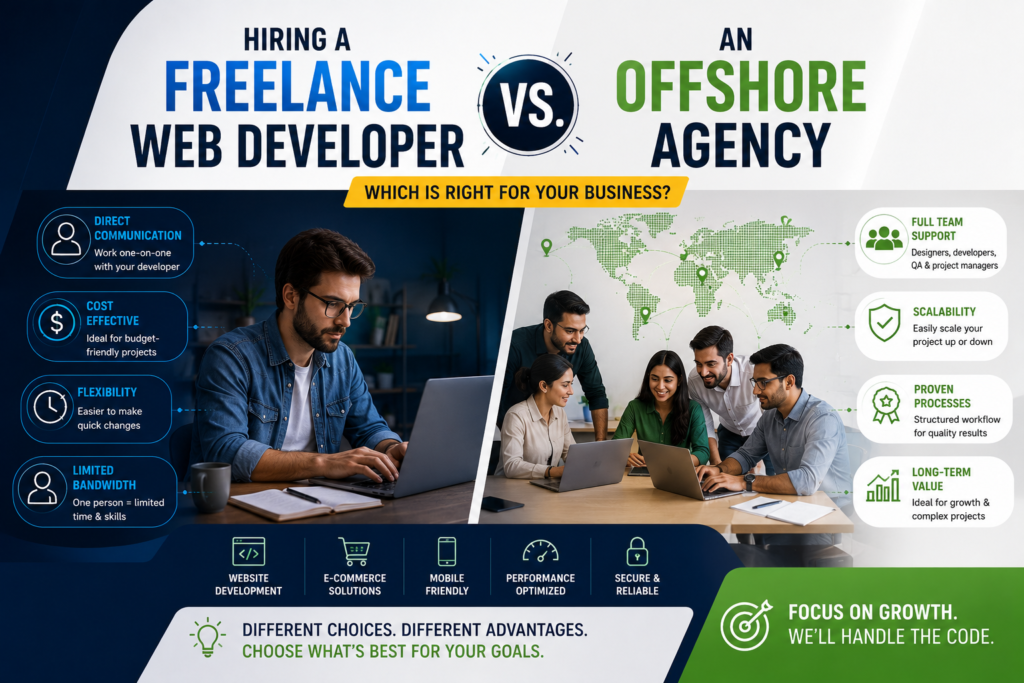
Freelance Web Developer vs. Offshore Agency: Which Is Right for You?
A comprehensive comparison of cost, quality, scalability, and management — to help you make the right choice for your business in 2026. Whether you’re a startup, scale‑up, or enterprise.
The Developer Dilemma: Freelance or Agency?
In 2026, businesses have more options than ever when it comes to building web applications. Two of the most popular paths are hiring a freelance web developer or partnering with an offshore agency. Both have their strengths and weaknesses — and the right choice depends on your specific needs, budget, and long‑term vision.
This guide breaks down the critical differences across 10 key dimensions, backed by 2026 data and real‑world insights. By the end, you’ll have a clear framework for making the decision that’s right for your business.
- Global offshore development market: $69B (up from $45B in 2022)
- Freelance platforms (Upwork, Fiverr, Toptal) have 12M+ registered developers
- Offshore agencies are growing at 18% YoY, driven by AI‑augmented development
- 75% of businesses now use a hybrid approach — freelancers for small tasks, agencies for major projects
Side‑by‑side: 10 key dimensions compared
| Dimension | Freelance Developer | Offshore Agency |
|---|---|---|
| Cost | $30 – 120/hr (varies by skill & location) | $20 – 80/hr (blended team rate) |
| Availability | Part‑time, often juggling multiple projects | Full‑time, dedicated team (or shared pool) |
| Skillset breadth | Narrow (specialist in one stack) | Broad (full‑stack, DevOps, QA, UX/UI) |
| Scalability | Limited — single person capacity | Infinite — team can grow with your needs |
| Project management | You manage everything | Agency manages — you get a dedicated PM |
| Risk mitigation | High — single point of failure | Low — shared risk, redundancy |
| Quality assurance | Self‑tested (if at all) | Dedicated QA team, automated testing |
| Time‑to‑market | Slow (single developer bottleneck) | Fast — parallel work streams |
| Support & maintenance | Limited, often ends after project | Ongoing support, SLA‑backed |
| Best for | Small fixes, MVPs, niche tasks | Complex projects, long‑term partnerships, enterprise |
Cost breakdown: What you really pay
The hourly rate is just the beginning. Here’s the full picture of costs — including hidden factors — for both options.
💼 Freelance Developer — Total Cost of Engagement
- Hourly rate: $30 – 120 (average $60 for experienced)
- Project management: Your team’s time (10‑20% overhead)
- Onboarding: 2‑4 weeks of context‑building (paid)
- Knowledge transfer: Often zero documentation
- Re‑hiring cost: If they leave, you start over
- Hidden cost: Quality issues, security gaps, technical debt
- True cost: 1.5x – 2x the hourly rate in overhead
🏢 Offshore Agency — Total Cost of Engagement
- Team rate: $20 – 80/hr (blended for team)
- Project management: Included (dedicated PM)
- Onboarding: Agency handles — 1‑2 week ramp‑up
- Documentation: Comprehensive, part of delivery
- Team continuity: Redundancy built in
- Hidden cost: Lower — QA, security, testing included
- True cost: 1.1x – 1.3x the hourly rate (all‑inclusive)
When to choose a freelancer vs. an offshore agency
Choose a Freelancer
Small bug fixes, simple landing pages, minor plugin updates, short‑term tasks, niche expertise (e.g., specific framework).
Best for: Small tasksChoose an Offshore Agency
Complex web applications, e‑commerce platforms, SaaS products, enterprise integrations, long‑term development, full‑stack projects.
Best for: Major projectsHybrid Approach
Use freelancers for quick wins and prototyping, and an agency for the core product. This gives you flexibility + scalability.
Best of both worldsQuality, reliability, and risk management
One of the biggest differences between freelancers and agencies is how they handle quality, reliability, and risk. Here’s what you need to know:
⚠️ Freelance Risks
- Single point of failure: If they get sick, leave, or take another project — your project stalls.
- No backup: No one else knows the codebase.
- Quality variability: No formal QA process.
- Security gaps: Often unaware of best practices.
- Knowledge loss: If they leave, you lose institutional knowledge.
- Scope creep: Harder to manage without formal processes.
✅ Agency Reliability
- Redundancy: Multiple developers can step in.
- Documentation: Comprehensive handover documents.
- Formal QA: Dedicated quality assurance team.
- Security focus: Adherence to OWASP and best practices.
- Knowledge retention: Agency retains knowledge, not individuals.
- Scope management: Clear change control processes.
Scalability: growing your development capacity
Your development needs will change over time. Here’s how each option handles growth:
📈 Freelance Scalability
- Limited: One person can only do so much.
- To scale, you must: Hire more freelancers (new onboarding, new context).
- Coordination overhead: Managing multiple freelancers is complex.
- Inconsistent quality: Different freelancers = different standards.
- Time to scale: Weeks to months to find and onboard.
🚀 Agency Scalability
- Instant: Agencies can add team members immediately.
- Consistent quality: All developers follow agency standards.
- No onboarding friction: Agency handles internal training.
- Flexible capacity: Scale up or down as needed.
- Time to scale: 24‑48 hours to add new team members.
Management overhead: who’s really running the show?
One of the most underestimated costs of working with freelancers is the management overhead. Here’s how it compares:
- Freelancer: You (or your team) must manage the freelancer — daily check‑ins, task assignment, code reviews, quality control, and progress tracking. This typically consumes 15‑25% of your team’s time.
- Offshore Agency: The agency provides a dedicated project manager who handles all coordination. You simply review progress and provide strategic direction. Your team spends 5‑10% of their time on oversight.
2026 trends shaping the freelance vs. agency landscape
- AI‑augmented development: Both freelancers and agencies are using AI tools (GitHub Copilot, Cursor) to accelerate coding. Agencies are faster to adopt and integrate these tools at scale.
- Remote‑first culture: The shift to remote work has made offshore agencies more accessible and integrated than ever.
- Rising rates: Freelancer rates have increased 15‑20% since 2022, while agency rates have remained stable due to economies of scale.
- Security & compliance: Agencies are investing heavily in ISO 27001 and SOC2 compliance — a critical differentiator for enterprise clients.
- Specialization: Freelancers are increasingly specializing (e.g., “React specialist”), while agencies offer full‑stack, end‑to‑end solutions.
- Hybrid models: 68% of businesses now use a combination of freelancers and agencies — freelancers for niche tasks, agencies for core development.
📊 Case study: From freelance chaos to agency excellence
A UK‑based SaaS startup initially hired a freelance developer to build their MVP. After 8 months, they had a partially working product, inconsistent code quality, and the developer went AWOL. They switched to an offshore agency for the rebuild.
- Freelance phase: 8 months, $75,000 spent, product at 40% completion, zero documentation, developer disappeared.
- Agency phase: 4 months, $60,000, product launched at 100%, full documentation, ongoing support.
- Key difference: The agency provided a dedicated PM, QA, and a team of 4 developers working in parallel.
- Outcome: The startup secured $2M in Series A funding within 6 months of launch — citing the “solid, scalable product” as a key factor.
Takeaway: While freelancers can work for small tasks, complex projects require the structure, redundancy, and expertise that only an agency can provide.
Your decision framework: 5 questions to ask yourself
Project complexity
Simple landing page → Freelancer. Complex SaaS → Agency.
Timeline
Need it fast? Agency with parallel work streams wins.
Budget
Freelancers seem cheaper, but agencies are often more cost‑effective for complete projects.
Risk tolerance
Can you afford a single point of failure? If not, choose an agency.
Long‑term vision
Planning to scale? Agencies are built for growth.
Frequently Asked Questions
Is a freelancer or agency better for an MVP?
For a simple MVP, a freelancer can work. However, if you plan to iterate and scale after launch, an agency will save you time and money in the long run — they build with scalability in mind from day one.
How do I ensure quality with an offshore agency?
Look for agencies with formal QA processes, code reviews, and testing frameworks. Ask for case studies and references. Use a trial project before committing to a long‑term engagement.
What about intellectual property (IP) protection?
Both freelancers and agencies should sign NDAs and IP assignment agreements. Agencies typically have more robust legal frameworks and are more experienced with IP protection for international clients.
Can I mix freelancers and an agency?
Yes. Many businesses use freelancers for small, isolated tasks (e.g., a specific plugin) and agencies for the core platform. This is the most flexible and cost‑effective approach.
How do I manage time zone differences with an offshore agency?
Most agencies work during overlapping hours or provide 24/7 coverage. Tools like Slack, Zoom, and Asana make collaboration seamless. Many agencies also offer “follow‑the‑sun” development.
What’s the average engagement length for an offshore agency?
Most agency engagements are 3‑12 months for a full project. Many clients stay on retainer for ongoing support and maintenance.
Making the right choice for your business
The decision between a freelance developer and an offshore agency isn’t about which is “better” — it’s about which is right for your specific situation. Both have their place in the 2026 development landscape.
If you need a quick fix, a simple landing page, or a niche technical skill — a freelancer is a great choice. If you’re building a core product that will drive your business for years — an offshore agency offers the scalability, quality, and reliability you need.
At Sherazi Marketing Solutions, we’ve helped dozens of UK and US businesses build world‑class web applications through our offshore agency model. We combine technical excellence with transparent communication, predictable delivery, and a genuine commitment to your success.
🚀 Ready to build with confidence?
Book a free consultation with our development team. We’ll discuss your project, recommend the best approach (freelancer, agency, or hybrid), and provide a no‑obligation proposal.
Start your project →No obligation. Just expert advice.