
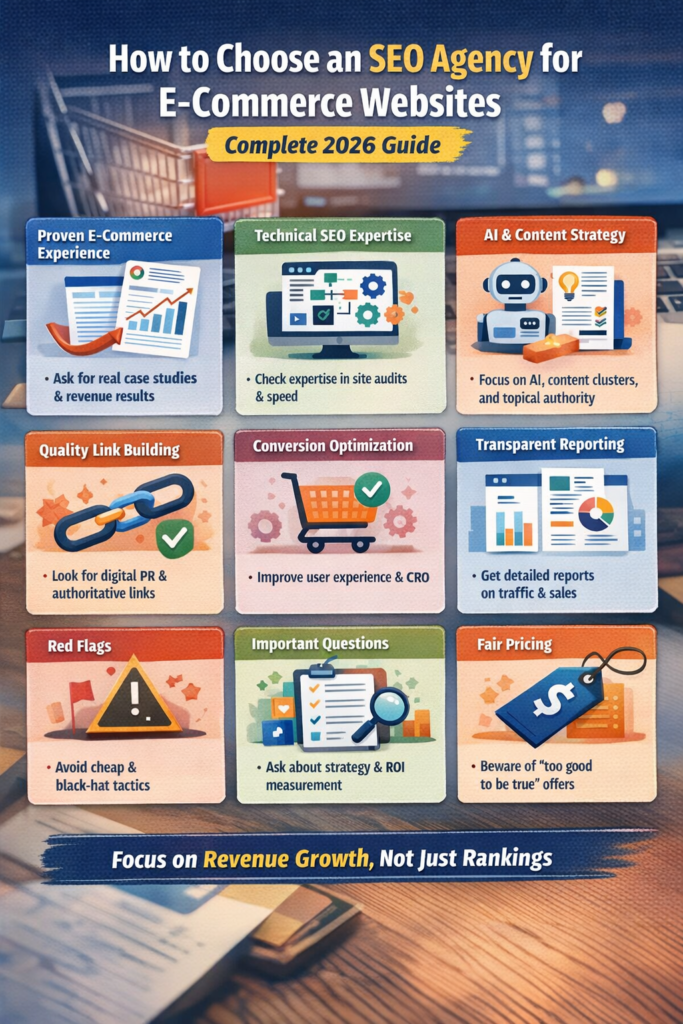
Choosing the right SEO agency for your e-commerce website can determine whether your store grows consistently or wastes time and budget. In online retail, traffic alone is not enough. You need qualified buyers, optimized product pages, strong technical SEO, and a strategy focused on revenue.
Whether your store runs on Shopify, WooCommerce, Magento, or BigCommerce, selecting the right SEO partner requires careful evaluation. This guide will help you make the right decision.
Why E-Commerce SEO Is Different
SEO for blogs and SEO for e-commerce websites are very different.
E-commerce SEO involves:
- Thousands of product URLs
- Complex category structures
- Faceted navigation and filters
- Duplicate content challenges
- Structured data for products
- Conversion rate optimization
- Technical performance and Core Web Vitals
A general SEO agency may understand rankings. A specialized e-commerce SEO agency understands revenue, product lifecycle, margins, and customer behavior.
1. Look for Proven E-Commerce Experience
Start with a simple question:
How many e-commerce websites have you ranked successfully?
Do not accept vague answers. Ask for:
- Real case studies
- Revenue growth data
- Organic sales improvements
- Keyword ranking comparisons
- Conversion rate improvements
A professional agency should show measurable growth in organic sales, not just traffic increases. They should clearly explain how they optimize product pages differently from category pages.
If they cannot explain that distinction, it is a red flag.
2. Evaluate Technical SEO Expertise
E-commerce websites are technically complex. Your agency must understand:
- Crawl optimization
- XML sitemap structuring
- Canonical tags
- Faceted navigation management
- Pagination handling
- Page speed optimization
- Structured data implementation
They should actively use professional SEO tools and provide technical audits.
Ask them how they handle duplicate content caused by filters and variations. If they struggle to explain it clearly, reconsider.
3. Assess Their AI and Content Strategy
Modern SEO is no longer just about keywords. It includes:
- AI search optimization
- Entity-based SEO
- Content clusters
- Topical authority
- Structured formatting
Your SEO agency should:
- Create buying guides
- Develop comparison content
- Optimize product descriptions
- Build topic clusters
- Structure content for AI readability
If they still focus heavily on keyword density, their approach may be outdated.
4. Review Their Link Building Strategy
Backlinks remain essential for ranking.
Avoid agencies that promise:
- Hundreds of backlinks in a few weeks
- Cheap link packages
- Guaranteed rankings
Instead, look for:
- Digital PR campaigns
- Guest posting on relevant sites
- Industry authority placements
- Product roundups
- Brand mentions
Quality backlinks matter far more than quantity.
Ask for examples of links they have built and how they evaluate link quality.
5. Check Their Conversion-Focused Approach
Traffic without conversions is meaningless.
A strong e-commerce SEO agency also considers:
- Conversion rate optimization
- User experience improvements
- Internal linking to high-profit pages
- Trust signals such as reviews and FAQs
- Clear product descriptions
SEO should align with revenue goals, not vanity metrics.
6. Demand Transparent Reporting
You should receive:
- Monthly progress reports
- Keyword tracking
- Traffic analysis
- Revenue attribution insights
- Technical improvement summaries
Ask how they measure success for e-commerce businesses.
The correct answer should focus on revenue growth and organic sales performance.
7. Understand Pricing and Expectations
E-commerce SEO requires consistent effort.
Be cautious of:
- Extremely cheap monthly retainers
- Guaranteed number one rankings
- Instant results promises
Effective SEO typically takes three to six months to show significant traction. It requires technical fixes, content development, and authority building.
Invest in strategy, not shortcuts.
8. Important Questions to Ask Before Hiring
Use this checklist:
- Do you specialize in e-commerce SEO?
- Can you provide real case studies?
- How do you handle technical SEO at scale?
- What is your link acquisition strategy?
- How do you optimize product descriptions?
- How do you measure return on investment?
- Who will manage my project directly?
Clear, confident, and transparent answers indicate professionalism.
9. Red Flags to Watch For
Avoid agencies that:
- Lack clear deliverables
- Focus only on traffic
- Ignore technical SEO
- Use black-hat tactics
- Provide vague reporting
- Promise unrealistic results
If something feels unrealistic, it probably is.
Final Thoughts
Choosing the right SEO agency for your e-commerce website is a long-term business decision.
The right partner will:
- Increase organic revenue
- Improve product and category rankings
- Strengthen brand authority
- Fix technical SEO issues
- Future-proof your store for AI-driven search
Take your time. Ask detailed questions. Focus on revenue, not just rankings.
Because in e-commerce, SEO is not about traffic.
It is about sustainable profit growth.